FAQs about EMS
- As EHS has indicated in their March 13 News Release, contract extensions would be issued to facilitate the negotiations of new single source contracts or the procurement process to secure an alternate service provider.
- EHS has also continued to message that they plan to have new contracts in place between April and September 2027 so it is the City’s understanding that the extension would only be for approximately 12 months past the September 30, 2026 contract end date, not 2.5 years. This would be achieved by EHS triggering the contract’s early termination clause.
- The City needs a long-term contract for planning and to create stability within the Lethbridge Fire & Emergency Services (LFES) department.
- All LFES ambulances are Advanced Life Support (ALS) units, meaning they can provide a higher level of care than Basic Life Support (BLS) units. – See FAQ on the difference in ALS and BLS.
- LFES’ integrated service provides an enhanced hazmat response when compared to fire-only departments.
- A Tactical Emergency Medical Support (TEMS) unit works with Lethbridge Police Service to embed paramedics in high-risk incidents to provide immediate medical care to injured civilians or officers.
What is changing?
Alta Paramedic Health (APH), formerly Emergency Health Services (EHS), informed the City of Lethbridge that, in order to negotiate a new EMS contract, the City would have to agree, in advance, to fund anything above the APH benchmark cost. City Council has chosen not to accept this condition due the financial impact on Lethbridge taxpayers. However, they do remain open to further negotiations and/or a procurement process to continue providing EMS in the community. APH has indicated that if the City did not accept, it would begin a procurement process to secure an EMS provider or move to a direct delivery model.
If the system isn’t broken, why try fix it?
Operationally, our system is solid. Our integrated Fire & EMS teams consistently provide excellent care for our community. Where it is broken is on the side of financial sustainability. As the contractor of the service, we cannot continue to get less funding from the Province and absorb the rising operating costs. Changes need to be made to make the system viable.
How can we make our system more sustainable?
There are several changes that will need to be made to make the system sustainable and the City is looking at all ways to improve efficiency.
The largest driver of costs is wages. Currently, all LFES members are paid at a firefighter's wage while most will exclusively do paramedic work for the first part of their career.
What the City has proposed to the IAFF union is that LFES paramedics get a comparable wage to provincial paramedic while they perform that duty. When/if they transition to Fire division and are doing both paramedic and firefighting work, they will get paid at a firefighter’s wage.
This would save approximately $1.6 million/year, reducing the need for tax increases but not eliminate it completely.
How were the Lethbridge EMS rates compared to the provincial rates?
A detailed analysis was done to most fairly compare the compensation of Lethbridge Fire & Emergency Services (LFES) paramedics with the provincial benchmark rate. When calculating its benchmark EMS delivery rate, Alta Paramedic Health (APH) used the rates paid to its own Advance Care Paramedics (ACP) and Primary Care Paramedics (PCP), represented by the Health Sciences Association of Alberta (HSAA) union.
There have been questions from the community about the wage comparisons and whether they are comparing apples to apples. Recognizing there are many differences between EMS agencies, particularly an integrated service, there has been extensive financial analysis done to most fairly compare rates. These comparisons are based on publicly available data, taking into account the differences in base wages, shift differentials, night shift premiums and weekend shift premiums.
Current wage comparison
LFES 1st Class Fire Fighter (>4 years of service) 2025 rate vs EHS Advanced Care Paramedic/Primary Care Paramedic Step 5 2025 (5 years service) rate
Classification | Lethbridge Fire & Emergency Services (LFES) Paramedics (not performing firefighting duties) | Health Sciences Association of Alberta (HSAA) | Difference in dollars | Different in percentage |
Advanced Care Paramedic | $125,456 | $106,835 | $18,622 | 17.4% |
Primary Care Paramedic | $125,456 | $90,011 | $35,455 | 39.4% |
Shouldn’t Lethbridge paramedics get paid more when they are both firefighters and paramedics?
Historically, Lethbridge Fire & Emergency Services (LFES) members have been trained as both firefighters and paramedics. However, the Province has told the City that paramedics can no longer respond to fire calls to perform firefighting duties.
Because of this, a new EMS division was created. New hires joining LFES are now exclusively paramedics for the first 5-8 years of their career. They can then choose to progress to firefighting or remain a paramedic. Going forward, fire training will not happen until members transition to the Fire division.
What the City is proposing is to pay paramedics a comparable paramedic wage while they perform that duty. When/if they transition to Fire division they will get paid at a firefighter’s wage. For those who are already cross-trained, if they work on a fire truck, they will get paid at the firefighter's wage.
Has EHS indicate that they wanted to pursue a contract extension?
On March 26, 2026 EHS indicated to the City that it wanted to pursue the contract extension option available in the current contract for 2.5 years. City Council did not accept this extension for several reasons.
Ultimately, this option would not provide any more certainty or stability to the Lethbridge Fire & Emergency Services department.
What does this mean for EMS in Lethbridge?
City Council is still committed to maintaining integrated Fire & Emergency Services and is pushing for sustainable solutions.
For more than a century, Lethbridge has operated an integrated Fire & Emergency Services model that provides a high standard of care for the community. Staff have been trained as both paramedics and firefighters with shared locations, training and resources.
Losing EMS would dismantle a system we have long supported and take great pride in. The City is hopeful it will have the opportunity to participate in a procurement process and continue providing EMS services in Lethbridge.
If a new EMS provider is procured or the province moves to a direct delivery model, they would not be integrated with the Fire Service. The City would transition to a Fire-only services.
What level of government is responsible for EMS?
When regional health authorities merged into Alberta Health Services (AHS) in 2009, EMS moved from a municipal to provincial responsibility. Since that time, the City has been contracted by EHS (formerly AHS) to provide EMS in Lethbridge.
What would the financial impact have been to the City if they had accepted the provincial contract conditions?
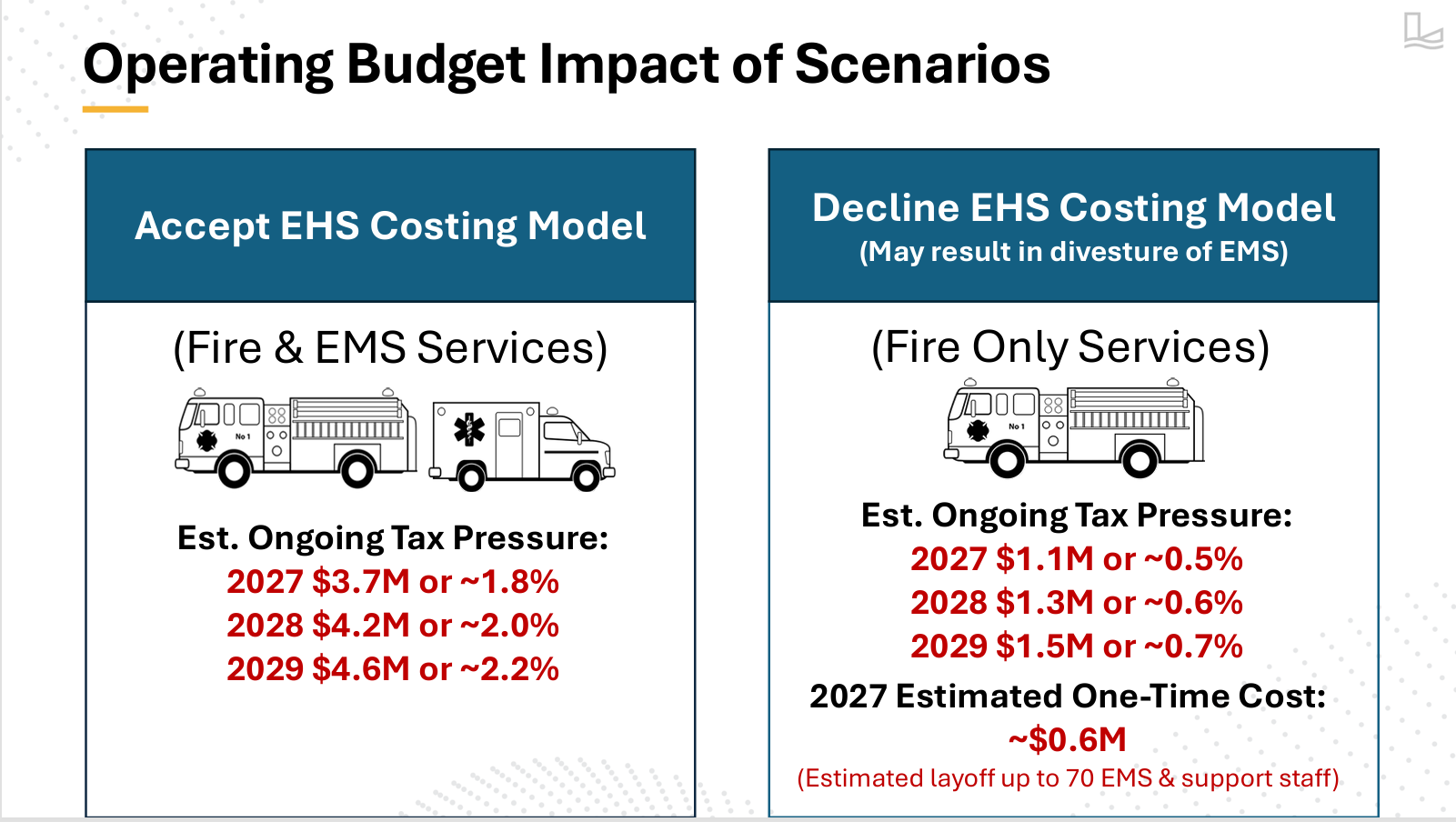
In addition to funding from the provincial EMS contract, local taxpayers contribute $3.5 million each year to maintain an integrated fire and EMS service. Proposed funding changes from EHS could have a significant impact on Lethbridge taxpayers, adding $3.7 million in local costs in 2027, a 1.8 per cent tax increase. That cost is expected to grow to $4.2 million in 2028 and $4.6 million by 2029.
On the flipside, if the City were to move to a fire-only service, there would still be an additional $1.1 million tax pressure. This is because there are many share costs between fire and EMS like building costs, supplies and training that will still need to be funded in a fire-only model. There would also be an estimated $600,000 in one-time costs to transition out of the integrated service.
To keep EMS, how much would taxes increase on the average house ($389,600)?
If the City were to accept the EHS contract conditions, the average Lethbridge homeowner ($389,600) would see the following tax increases for EMS.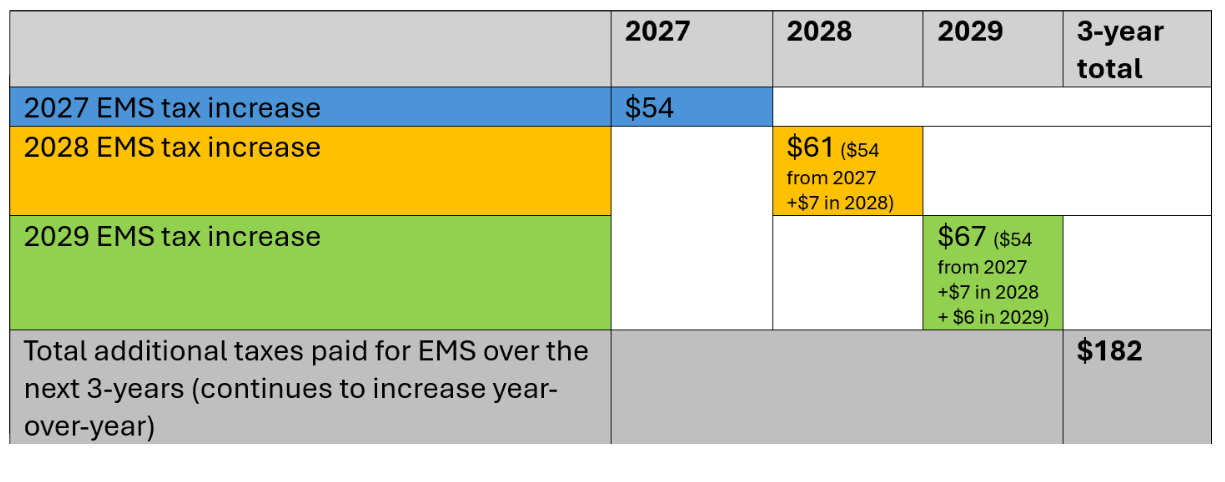
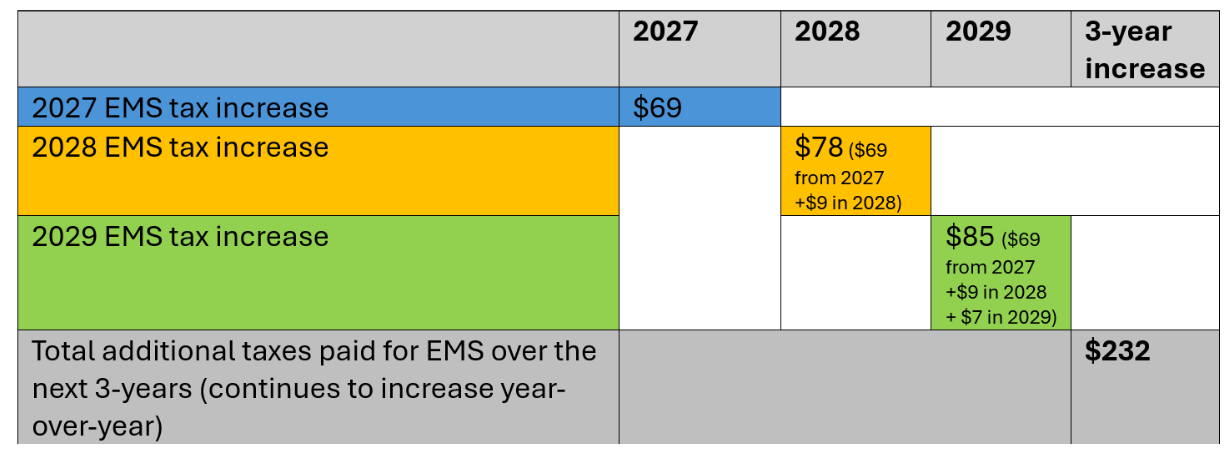
To keep EMS, how much would taxes increase on a $500,000 house?
If the City were to accept the EHS contract conditions, a homeowner with a $500,000 property would see the following tax increases for EMS:
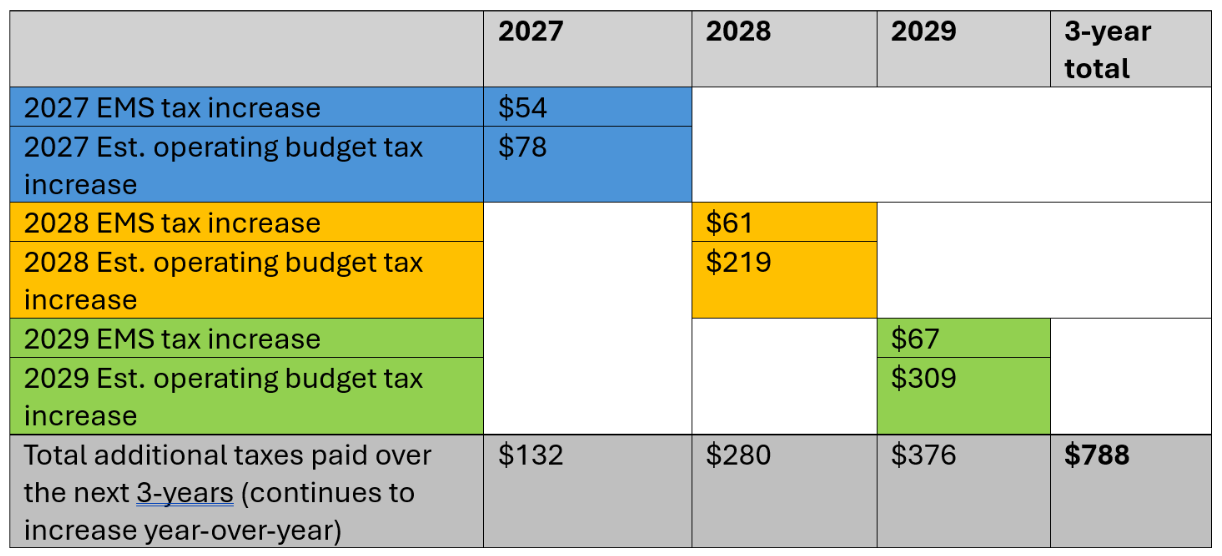
Would the EMS costs be the only increase in taxes?
No. The cost of EMS on its own might seem manageable but when compounded with other known tax pressures, the increase felt by residents becomes quite significant. Factoring in EMS and other know costs coming to the City, it is estimated a homeowner with the average house price of $389,600 will pay close to $800 more in taxes over the next three years.
Is Lethbridge the only community impacted by this change?
No, the City of Lethbridge is one of seven integrated services across the province. With the exception of the Municipality of Wood Buffalo, all were given the same contract notification from EHS.
The communities of Leduc, Spruce Grove and Lethbridge have not accepted the additional costs.
The communities of Red Deer, Strathcona County and St. Albert have accepted the additional costs.
How have EMS contracts been established in the past?
Since 2009, when EMS moved under provincial jurisdiction, contracts have been reached through collaborative negotiations..
When does the City’s contract with EHS end?
The current contract with EHS is set to expire on September 30, 2026.
What is an integrated Fire and EMS service?
Integrated Fire/EMS Services is a public safety service delivery model in which fire suppression, emergency medical services (EMS), rescue, and related emergency response functions are provided through a single, unified organization. Personnel are cross-trained and resources are shared, allowing for coordinated command, deployment, and response to both fire and medical emergencies from the same stations under a common governance and operational structure.
What service does Lethbridge Fire and Emergency Services (LFES) provide?
Lethbridge currently provides an integrated Fire and EMS service which allows for enhanced coordination of emergency response.
What is the difference between an Advanced Life Support (ALS) ambulance and a Basic Life Support (BLS) ambulance?
In Alberta, ambulances are either Advanced Life Support (ALS) or Basic Life Support (BLS). ALS ambulances are staffed by highly trained paramedics and can provide advanced medical care, including medications and life‑saving treatments, before reaching the hospital. BLS ambulances provide essential care such as CPR, oxygen and patient stabilization, but do not offer the same level of advanced treatment. In Lethbridge all ambulances are ALS.