Changes to Emergency Medical Services Contracts
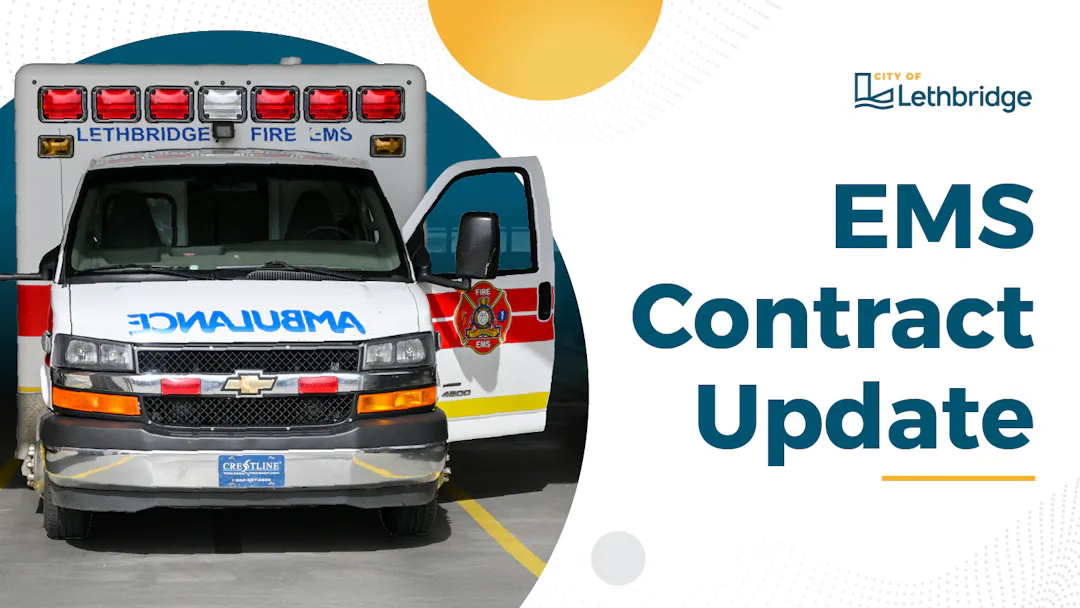
The City of Lethbridge remains committed to integrated Fire & Emergency Medical Services (EMS). On May 12, City Council made the difficult decision to not accept new contract conditions from Emergency Health Services (EHS) - Alberta due to the impacts it would have on Lethbridge taxpayers. However, the City remains open to further discussions with partners or a future procurement process that could allow Lethbridge to continue its integrated Fire and EMS model.
The City of Lethbridge remains committed to integrated Fire & Emergency Medical Services (EMS). On May 12, City Council made the difficult decision to not accept new contract conditions from Emergency Health Services (EHS) - Alberta due to the impacts it would have on Lethbridge taxpayers. However, the City remains open to further discussions with partners or a future procurement process that could allow Lethbridge to continue its integrated Fire and EMS model.
-
City reveals EMS cost pressures, continues push for sustainable solution
Share City reveals EMS cost pressures, continues push for sustainable solution on Facebook Share City reveals EMS cost pressures, continues push for sustainable solution on Twitter Share City reveals EMS cost pressures, continues push for sustainable solution on Linkedin Email City reveals EMS cost pressures, continues push for sustainable solution linkFollowing Council’s decision to not accept the new provincial contract conditions for Emergency Medical Services (EMS), work has be
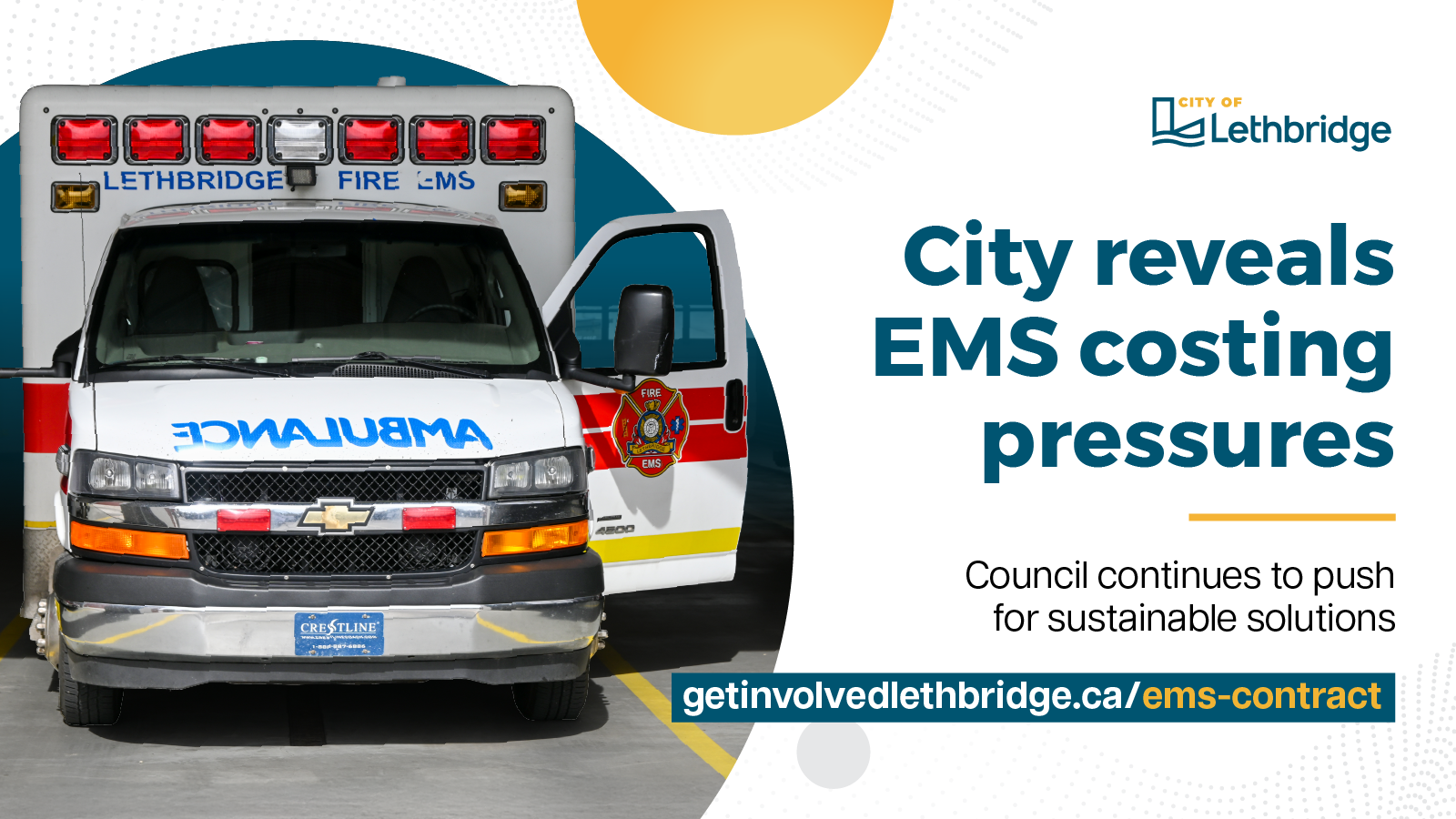 en ongoing to preserve the City’s integrated Fire & EMS system. This includes discussions with the International Association of Fire Fighters (IAFF) union.
“As we have said from the beginning, City Council supports our integrated service and is looking for sustainable ways to continue providing EMS in our community,” says Mayor Blaine Hyggen. “I personally believe we have brought forward tangible solutions to the IAFF. We want to be open and transparent with our residents on the efforts we areContinue reading
Following Council’s decision to not accept the new provincial contract conditions for Emergency Medical Services (EMS), work has be
en ongoing to preserve the City’s integrated Fire & EMS system. This includes discussions with the International Association of Fire Fighters (IAFF) union.“As we have said from the beginning, City Council supports our integrated service and is looking for sustainable ways to continue providing EMS in our community,” says Mayor Blaine Hyggen. “I personally believe we have brought forward tangible solutions to the IAFF. We want to be open and transparent with our residents on the efforts we are putting forward and provide a clear understanding of the challenges we’re facing.”
ALTA Paramedic Health (APH), formerly Emergency Health Services (EHS) - Alberta, has indicated that the City’s EMS services are more costly than its benchmark. One of the main drivers of this difference is wages. In some instances, LFES employees staffing ambulances make close to 40 per cent higher than the EHS Benchmark. See backgrounder below for detailed wage comparators.
City Proposal to IAFF
Following direction from Council, City Administration met with IAFF Local 237 to propose options aimed at better aligning Lethbridge EMS compensation with provincial paramedic rates. IAFF has since advised that it is not prepared to accept the City’s proposal.The option proposed by City Administration would help reduce projected tax subsidies to support the integrated service. However, it would not eliminate an increase to property taxes. Part of the option proposed by City Administration also included wage adjustments for the LFES Chief and Deputy Chiefs.
“In my opinion, there are several things that need to be addressed to get us to the appropriate costing level, but wages are a big part of that solution,” says Mayor Hyggen. “The City is also actively looking at other ways to address cost pressures.”
Next Steps
At this time, the City will prepare to respond to a potential procurement process for local EMS service delivery and any other opportunities for further negotiations with partners.The City hopes to continue discussions with IAFF and City administration will continue to work on finding ways to create efficiencies and cost savings.
Backgrounder
Cost Calculations
When calculating its benchmark EMS delivery rate, APH has indicated that it used the rates paid to its own Advance Care Paramedics (ACP) and Primary Care Paramedics (PCP), represented by the Health Sciences Association of Alberta (HSAA) union.
The City faces significant financial pressures to meet these provincial cost expectations under its current compensation structure as an integrated service. All LFES employees currently get paid a fire fighter wage which is much higher than the HSAA paramedic rates.
The City has calculated the difference between the yearly wages paid to EHS employees vs. LFES EMS employees. These comparisons are based on publicly available data and are intended to provide high-level context, taking into account base wages, differentials and premiums.
Current wage comparison
LFES 1st Class Fire Fighter (>4 years of service) 2025 rate vs EHS Advanced Care Paramedic/Primary Care Paramedic Step 5 2025 (5 years service) rate
Classification
Lethbridge Fire & Emergency Services (LFES)
Health Sciences Association of Alberta (HSAA)
Difference in dollars
Different in percentage
Advanced Care Paramedic
$125,456
$106,835
$18,622
17.4%
Primary Care Paramedic
$125,456
$90,011
$35,455
39.4%
Historical Integrated Structure
The City’s integrated service means employees are cross-trained as both fire fighters and paramedics. This allows for a coordinated response and efficiencies in staffing. Traditionally, new LFES employees were provided with fire training following their hire but served the first part of their career (approximately 5-8 years) predominantly as a paramedic. They could however be dispatched to aid in fire suppression while responding on an ambulance.
Under this model, all LFES employees are paid the fire fighter rate which is based on comparative fire fighter rates within the province.
Introduction of the EMS division
During the last round of EMS contract negotiations with the Province, the City was advised that for any contract renewal or extension, the City would no longer be allowed to dispatch ambulances to support fire calls.
In response, the City worked with IAFF Local 237 during collective bargaining to create a new EMS Division.
- The goal of the EMS Division was to improve operational efficiency and reduce costs, recognizing paramedics would no longer be allowed to provide fire support
- The model allows LFES employees to transition into firefighter roles over time, while delaying training and adjusting wages until they reach that position
- It also gives employees the option to remain in the EMS Division as career paramedics
- This approach is a first-of-its-kind model which was aimed at helping reduce the wage gap between LFES and provincial (EHS) benchmark rates while maintaining integrated services
New EMS division wage comparison
The new EMS division established lower wages rates for new LFES hires. However, the rates are still significantly above HSAA rates.
LFES 1st Class EMS Division Employee (>4 years of service) 2025 rate vs EHS Advanced Care Paramedic/Primary Care Paramedic Step 5 (5 years of service) 2025 rate.
Classification
Lethbridge Fire & Emergency Services (LFES)
Health Sciences Association of Alberta (HSAA)
Difference in dollars
Different in percentage
Advanced Care Paramedic
$119,247
$106,835
$12,412
11.6%
Primary Care Paramedic
$106,829
$90,011
$16,818
18.7%
Note: This new wage structure has not yet been implemented and only applies to new LFES employees hired after December 2, 2025.
Why hasn’t the EMS Division been implemented?
The EMS Division was slated to be gradually implemented following ratification of the new collective agreement on December 2, 2025. Hiring into the new EMS Division was paused when the City was notified on March 13, 2026 of the new EHS contract conditions. The City did not expect to realize the full cost savings of the EMS Division for seven to ten years due to staff attrition. When fully implemented, the new model is expected to save approximately $700,000/year.
Who is responsible for providing ambulance services in Alberta?
In 2009, the provincial government assumed responsibility for the delivery of centralized ambulance services through Alberta Health Services. Although this change moved the responsibility and control of ambulance services to the province, City continued to provide ground ambulance services in Lethbridge under contract with Alberta Health Services, now EHS. Under the provincial model, EHS is responsible for directing resources and determining provincial service levels.
Note: The wage comparisons provided are for high-level context only. There are a multitude of items that factor into total compensation such as overtime, paid leaves, benefits, pension etc.
-
City remains committed to integrated Fire & EMS
Share City remains committed to integrated Fire & EMS on Facebook Share City remains committed to integrated Fire & EMS on Twitter Share City remains committed to integrated Fire & EMS on Linkedin Email City remains committed to integrated Fire & EMS link
Yesterday, City Council made a very difficult decision in an effort to find a sustainable way to maintain Lethbridge’s integrated Fire & Emergency Medical Services (EMS). Refusing the financial impacts of Emergency Health Services (EHS) – Alberta’s contract conditions does not mean the City wants to walk away from an integrated service. It means that an alternative solution needs to be found. This continues to be the direction of City Council.
The Importance of EMS
City Council supports and values integrated emergency services. For more than a century, this model has supported the health and safety of the community byContinue readingYesterday, City Council made a very difficult decision in an effort to find a sustainable way to maintain Lethbridge’s integrated Fire & Emergency Medical Services (EMS). Refusing the financial impacts of Emergency Health Services (EHS) – Alberta’s contract conditions does not mean the City wants to walk away from an integrated service. It means that an alternative solution needs to be found. This continues to be the direction of City Council.
The Importance of EMS
City Council supports and values integrated emergency services. For more than a century, this model has supported the health and safety of the community by providing a high standard of care. City Council and Administration continue to focus on solutions that will preserve this system.Community Feedback
Over the last few weeks, hundreds of residents have expressed their concerns over losing integrated Fire & EMS. Those concerns are being heard, and all efforts are being made to find a solution that can create a sustainable way forward. Thank you to the community for sharing your thoughts, concerns and stories on this important and impactful issue.Cost of Service
The emergency services operated in Lethbridge are very high quality and effective, but that level of service is also expensive. These are provincial health care costs that will continue to escalate for Lethbridge taxpayers if not addressed.To help mitigate costs, an EMS-only division was introduced in the latest collective agreement between the City and the International Association of Fire Fighters (IAFF) union. This is a first-of-its-kind, innovative solution to reduce wage costs. The City had expected time and collaboration from EHS to implement this system and work on options that could make both organizations successful. Unfortunately, that has not been the reality.
Other Pressures
There are several financial pressures facing the City. Some of these are impacts from Provincial decisions like the cost of body worn cameras and loss of photo radar revenue. Some are needs that fall squarely within the municipality’s responsibility and must be addressed. Council has to look at the big picture of all needs when considering budgets. That is why the goal is to find a more financially sustainable way to maintain the integrated service.Next Steps
This is a highly complex issue with many moving parts including operational considerations, service delivery standards, staffing, governance and long-term financial sustainability. Now that the decision has been made to not accept the EHS contract condition, more important work is ahead.New approaches like reducing non-emergent interfacility transfers could be explored to create efficiencies. The City remains optimistic that we can work with our partners to find these types of solution to meet the needs of our community and frontline responders. This could include further negotiations and/or responding to an expression of interest from the Province.
More Information
A full list of FAQs, timelines, key dates and news updates on this issue is available at: https://getinvolvedlethbridge.ca/ems-contract -
City does not accept provincial EMS contract conditions
Share City does not accept provincial EMS contract conditions on Facebook Share City does not accept provincial EMS contract conditions on Twitter Share City does not accept provincial EMS contract conditions on Linkedin Email City does not accept provincial EMS contract conditions linkThe City of Lethbridge will not accept Emergency Health Services (EHS) – Alberta’s new contract conditions due to the significant financial impact it would have on Lethbridge taxpayers. However, the City is keeping the door open for further discussions or a future procurement process that could allow Lethbridge to continue its integrated Fire and EMS model.
“I want the community and our staff to understand that this is not a decision to walk away from integrated Fire and EMS,” says Mayor Blaine Hyggen. “It’s only about the unachievable EHS contract condition we have been given. What Council would like toContinue reading
The City of Lethbridge will not accept Emergency Health Services (EHS) – Alberta’s new contract conditions due to the significant financial impact it would have on Lethbridge taxpayers. However, the City is keeping the door open for further discussions or a future procurement process that could allow Lethbridge to continue its integrated Fire and EMS model.
“I want the community and our staff to understand that this is not a decision to walk away from integrated Fire and EMS,” says Mayor Blaine Hyggen. “It’s only about the unachievable EHS contract condition we have been given. What Council would like to see is the opportunity to collaborate with our partners on options that could work for all parties.”
After a motion to rescind the previous decision was defeated (7–2), City Council upheld its original decision, which was approved 9-0 on March 24. This motion directed City Administration to:
- Strategically notify Emergency Health Services – Alberta that the City of Lethbridge does not agree in advance to cover any additional costs associated with a new EMS Ground Ambulance Agreement while preserving the City’s right to participate in further negotiations and/or a request for proposals process.
Figures presented at the April 30 Community Issues Committee meeting show EHS funding changes could add $3.7 million in local costs in 2027, a 1.8 per cent tax increase. That cost was expected to grow to $4.2 million in 2028 and $4.6 million by 2029.
Over the next three years, the average Lethbridge home ($387,000), would have paid an additional $182 in taxes, just to support EMS. This would be above and beyond Provincial education tax increases (collected on municipal property taxes) and other significant cost pressures facing the City.
“We know the financial pressures this would put on our City budgets,” says Chief Financial Officer & Treasurer, Darrell Mathews. “These costs will continue to escalate, and we know that is not sustainable in the future.”
Council also voted (7–2) not to extend the current contract beyond its end date of September 30, 2026. EHS has indicated new contracts would be in place as early as April 2027, the City believes extending the current agreement would just create more uncertainty for Lethbridge Fire and Emergency Services.
EHS has said that if the City did not agree to taking on additional costs, they would move to an open procurement process or a direct delivery model to operate local EMS.
The City remains open to further talks with its partners. If EHS makes the decision to continue with procurement, the City will evaluate all options and the viability of submitting a proposal.
-
Council extends EMS contract discussions to May 12
Share Council extends EMS contract discussions to May 12 on Facebook Share Council extends EMS contract discussions to May 12 on Twitter Share Council extends EMS contract discussions to May 12 on Linkedin Email Council extends EMS contract discussions to May 12 linkUnderstanding the magnitude of a decision that could impact the City’s Emergency Medical Services (EMS), City Council will have further discussions regarding the Province’s new EMS costing model.
“This is an extremely complex issue and there is a large volume of information being received from many different perspectives. Council is working to sort that out as we move towards a final decision,” says Mayor Blaine Hyggen. “We expect further discussion on May 12. We know this is difficult for our community and our staff and we thank them for their patience and understanding.”
Due to a procedural error, there was no motion to vote on today regarding the new contract conditions presented by EHS. Council instead publicly disclosed confidential direction that had already been approved.
On March 24, in a 9-0 vote, City Council directed City Administration to:
- Engage in collaborative efforts with the “Integrated 6” to present a unified response to EHS; and
- Strategically notify Emergency Health Services – Alberta that the City of Lethbridge does not agree in advance to cover any additional costs associated with a new EMS Ground Ambulance Agreement while preserving the City’s right to participate in further negotiations and/or a request for proposals process
- Contact IAFF and show them the very high-level additional tax support that would be required, and float the wage reduction discussion, to match and be no higher than HSAA Rates.
Direction No. 2 had not yet been completed as moving deadlines and changing information delayed any notification to EHS. Because there has been no action on this item, the decision could be rescinded with a two-thirds Council vote.
“In my mind, a lot has changed since March 24,” says Acting Mayor Jenn Schmidt-Rempel, “I do intend to bring this back to the May 12 Council meeting so we can vote on rescinding direction No. 2 of the motion and reconsider our decision on not accepting the EHS contract conditions.”
Council also postponed a decision on a proposed EHS contract extension as it will be impacted by the direction Council takes at the next meeting.
Figures presented at last week’s CIC meeting show EHS funding changes could add $3.7 million in local costs in 2027, a 1.8 per cent tax increase. That cost is expected to grow to $4.2 million in 2028 and $4.6 million by 2029.
EHS has said that if the City does not agree to taking on additional costs, they will move to an open procurement process or a direct delivery model to provide EMS services locally.
Understanding the magnitude of a decision that could impact the City’s Emergency Medical Services (EMS), City Council will have further discussions regarding the Province’s new EMS costing model.
“This is an extremely complex issue and there is a large volume of information being received from many different perspectives. Council is working to sort that out as we move towards a final decision,” says Mayor Blaine Hyggen. “We expect further discussion on May 12. We know this is difficult for our community and our staff and we thank them for their patience and understanding.”
Due to a procedural error, there was no motion to vote on today regarding the new contract conditions presented by EHS. Council instead publicly disclosed confidential direction that had already been approved.
On March 24, in a 9-0 vote, City Council directed City Administration to:
- Engage in collaborative efforts with the “Integrated 6” to present a unified response to EHS; and
- Strategically notify Emergency Health Services – Alberta that the City of Lethbridge does not agree in advance to cover any additional costs associated with a new EMS Ground Ambulance Agreement while preserving the City’s right to participate in further negotiations and/or a request for proposals process
- Contact IAFF and show them the very high-level additional tax support that would be required, and float the wage reduction discussion, to match and be no higher than HSAA Rates.
Direction No. 2 had not yet been completed as moving deadlines and changing information delayed any notification to EHS. Because there has been no action on this item, the decision could be rescinded with a two-thirds Council vote.
“In my mind, a lot has changed since March 24,” says Acting Mayor Jenn Schmidt-Rempel, “I do intend to bring this back to the May 12 Council meeting so we can vote on rescinding direction No. 2 of the motion and reconsider our decision on not accepting the EHS contract conditions.”
Council also postponed a decision on a proposed EHS contract extension as it will be impacted by the direction Council takes at the next meeting.
Figures presented at last week’s CIC meeting show EHS funding changes could add $3.7 million in local costs in 2027, a 1.8 per cent tax increase. That cost is expected to grow to $4.2 million in 2028 and $4.6 million by 2029.
EHS has said that if the City does not agree to taking on additional costs, they will move to an open procurement process or a direct delivery model to provide EMS services locally.
-
Analysis shows significant impact of new EMS costing model
Share Analysis shows significant impact of new EMS costing model on Facebook Share Analysis shows significant impact of new EMS costing model on Twitter Share Analysis shows significant impact of new EMS costing model on Linkedin Email Analysis shows significant impact of new EMS costing model linkDue to the major financial impact on Lethbridge taxpayers, City administration is recommending City Council not accept the Province’s new contract conditions for emergency medical services (EMS), while preserving the right to participate in further negotiations and/or request for proposal processes.
On March 13, Emergency Health Services (EHS) – Alberta notified the City that before negotiations on a new EMS contract could begin, the City would need to agree in advance to cover any costs above the provincial funding benchmark. As Council learned at today’s Community Issues Committee meeting, this change could significantly increase costs for local taxpayers.
Council isContinue reading
Due to the major financial impact on Lethbridge taxpayers, City administration is recommending City Council not accept the Province’s new contract conditions for emergency medical services (EMS), while preserving the right to participate in further negotiations and/or request for proposal processes.
On March 13, Emergency Health Services (EHS) – Alberta notified the City that before negotiations on a new EMS contract could begin, the City would need to agree in advance to cover any costs above the provincial funding benchmark. As Council learned at today’s Community Issues Committee meeting, this change could significantly increase costs for local taxpayers.
Council is expected to make a decision on how to proceed at a special meeting of City Council on May 5.
“Over the past several weeks, we’ve spent a significant amount of time carefully reviewing what these changes would mean for Lethbridge,” says Chief Financial Officer & Treasurer, Darrell Mathews. “We’ve worked with EHS to clarify as many details as we could and ensure City Council has clear, accurate information.”
Lethbridge currently provides an enhanced level of service by integrating Fire and EMS. This means staff are trained as both firefighters and paramedics. In addition to funding from the provincial EMS contract, local taxpayers contribute $3.5 million each year to maintain this service. Proposed funding changes from EHS could have a significant impact on Lethbridge taxpayers, adding $3.7 million in local costs in 2027, a 1.8 per cent tax increase. That cost is expected to grow to $4.2 million in 2028 and $4.6 million by 2029.
“This decision impacts people and that is not something anyone takes lightly,” says Mayor Blaine Hyggen. “Today’s presentation shows how complex this issue is and the many different factors that need to be weighed. We are grateful for the time and effort staff have put into providing the analysis we need to support our decision-making.”
Along with the financial analysis, Council received information on the operational impacts should the City discontinue local EMS. Moving to a Fire-only service would mean the loss of approximately 70 EMS and support staff positions. There are also efficiencies today by having Fire and EMS share expenses for things like building costs, supplies and training. These would still need to be funded in a Fire-only model, creating an ongoing tax pressure of approximately $1.1 million per year or a 0.5 per cent tax increase. There would also be an estimated one-time cost of $600,000 in 2027 to support the transition out of integrated service.
“We are disappointed with how this process has rolled out,” says Mayor Hyggen. “As we learned today, this decision will have a tax implication on Lethbridge residents, regardless of what decision Council makes. That is a frustrating position to be in.”
Some of the service level impacts that could be felt by the community if EMS were to go to the Provincial service level standard may include:
- A blend of Advanced Life Support (ALS) and Basic Life Support (BLS) vs the current service level of all ALS ambulances
- A reduction in the amount of time ambulances are fully staffed, meaning there may be more periods when ambulances are not available, affecting response times
- Ambulance locations set by provincial EHS planning rather than at the current strategically located Fire Stations
- An increase in out-of-community deployments due to provincial demand
- Decrease in efficiency and collaboration at emergency events if there are two responding organizations rather than just one
- The loss of the local Tactical EMS team that supports LPS events
Today’s administrative recommendation also suggests Council not accept the 2.5-year contract extension that EHS has indicated they would like to pursue. Based on public messaging from EHS, the intent of the extension is to give it more time to put in place new single source contracts or complete a procurement process to secure an alternate service provider. This would likely be a maximum of 12 months, not 2.5 years. Agreeing to the extension would not provide any added stability or certainty for the current integrated fire and EMS.
City Council has until May 31 to inform EHS of their decision. If Council does not agree to take on the additional cost, EHS has indicated they will move to either an open procurement process or a direct delivery model. If EHS initiates a procurement process, the City would have the option to submit a proposal at that time.
For full details on this issue visit: https://getinvolvedlethbridge.ca/ems-contract
-
City asking for provincial EMS contract talks to continue
Share City asking for provincial EMS contract talks to continue on Facebook Share City asking for provincial EMS contract talks to continue on Twitter Share City asking for provincial EMS contract talks to continue on Linkedin Email City asking for provincial EMS contract talks to continue linkUnderstanding the critical importance of Emergency Medical Services (EMS) to the community, City Council is seeking more time and information related to contract options with Emergency Health Services – Alberta (EHS). Today, Council voted unanimously to advocate to the Alberta Government, asking that they work with municipalities, as partners, on EMS delivery.
On March 13, EHS notified the City that, to enter negotiations for a new EMS contract, the municipality would have to agree in advance to fund anything above the EHS benchmark cost. The City was originally given until just March 31, 2026 to make this decision. Earlier todayContinue reading
Understanding the critical importance of Emergency Medical Services (EMS) to the community, City Council is seeking more time and information related to contract options with Emergency Health Services – Alberta (EHS). Today, Council voted unanimously to advocate to the Alberta Government, asking that they work with municipalities, as partners, on EMS delivery.
On March 13, EHS notified the City that, to enter negotiations for a new EMS contract, the municipality would have to agree in advance to fund anything above the EHS benchmark cost. The City was originally given until just March 31, 2026 to make this decision. Earlier today, EHS provided notification that the deadline has been extended to May 31, 2026.
Council agreed to send a joint advocacy letter, with six other municipalities in Alberta providing integrated fire and emergency services. The letter to the Minister of Public Safety and Emergency Services will request a meeting between the Mayors and the Minister to further discuss EMS contracts.
“This development is something that has come up very quickly and could have a significant impact on our community,” says Mayor Blaine Hyggen. “We know EMS is extremely important to the health and safety of our residents. That’s why it is vital that we be given time to discuss with our provincial partners as well as complete detailed financial and operation analysis to help us evaluate the best way forward.”
Lethbridge City Council has supported providing a higher standard of service to the community through an integrated Fire and Emergency Services model. This involves both a strong EHS partnership as well as additional municipal funding. What is currently being offered by EHS would provide the City with less funding than the current EMS contract, which ends September 30, 2026.
For more than 100 years, the City has recognized the integrated Fire and EMS system as an effective way to provide best-in-class care. Since 2009, when EMS moved under provincial jurisdiction, this has been achieved through a contract with EHS (formerly Alberta Health Services).
In Lethbridge, staff are trained as both paramedics and firefighters, sharing resources, training and co-locating at fire stations. The City has recently introduced an EMS division that would allow some staff to be trained solely as paramedics, giving more flexibility to the system and creating potential cost efficiencies in the future. This new model is in its early days of implementation.
“We know emergency services are highly valued by our residents, and we want to continue to providing that care for our community, without burdening our taxpayers with additional costs,” says Mayor Hyggen. “We appreciate the dedicated men and women working within Lethbridge Fire and Emergency Services team who continue to protect the health and wellbeing of our community every day.”
EHS indicated that if the City did not agree in advance to fund all additional costs greater than those stipulated by EHS for providing EMS, a procurement process will begin to secure a service provider. Similar communications have gone to other Alberta municipalities that are contracted to provide EMS. More details of that procurement are currently unknown.
FAQs about EMS
- What is changing?
- If the system isn’t broken, why try fix it?
- How can we make our system more sustainable?
- How were the Lethbridge EMS rates compared to the provincial rates?
- Shouldn’t Lethbridge paramedics get paid more when they are both firefighters and paramedics?
- Has APH (formerly EHS) indicate that they wanted to pursue a contract extension?
- What does this mean for EMS in Lethbridge?
- What level of government is responsible for EMS?
- What would the financial impact have been to the City if they had accepted the provincial contract conditions?
- To keep EMS, how much would taxes increase on the average house ($389,600)?
- To keep EMS, how much would taxes increase on a $500,000 house?
- Would the EMS costs be the only increase in taxes?
- Is Lethbridge the only community impacted by this change?
- How have EMS contracts been established in the past?
- When does the City’s contract with EHS end?
- What is an integrated Fire and EMS service?
- What service does Lethbridge Fire and Emergency Services (LFES) provide?
- What is the difference between an Advanced Life Support (ALS) ambulance and a Basic Life Support (BLS) ambulance?
Key Dates
-
May 20 2026
-
Council decides not to accept EHS contract conditions but remains committed to integrated Fire & EMSMay 12 2026
-
May 05 2026
-
April 30 2026
-
April 15 2026
-
March 13 → March 23 2026
-
March 20 2026
-
March 11 2026
-
March 24 2026
-
March 31 2026
-
April 01 2026
-
March 24 2026
-
March 23 2026
-
March 13 2026